Some men walk into a room and demand attention.
Others try to disappear into the paintwork.
Cole belonged to the second kind.
He did not want anyone to notice him. He did not want conversation, respect, questions, or thanks. He wanted a broken heater, a quiet room, a clean repair, and the familiar weight of his tools when the job was done.
That was all.
But when two arrogant black belt brothers decided to use the quiet mechanic fixing their dojo’s radiator as a heavy bag, they did not realize they had just cornered a ghost.
And ghosts, when cornered, remember what they used to be.
Cole did not care about the smell of sweat inside Summit Grappling.
He was used to worse.
He was used to burning diesel, old blood, wet sand, and the sharp ozone scent that lingered after a flashbang cleared a compound. Compared to that, the faint odor of damp canvas, athletic tape, and industrial floor cleaner was almost sterile.
It was 9:30 on a Tuesday night.
The strip mall outside was a graveyard of dark storefronts. A nail salon with its blinds drawn. A tax office with one flickering security light. A pizza place closed since eight. Only Summit Grappling still glowed, red neon spilling through the front windows onto the empty parking lot.
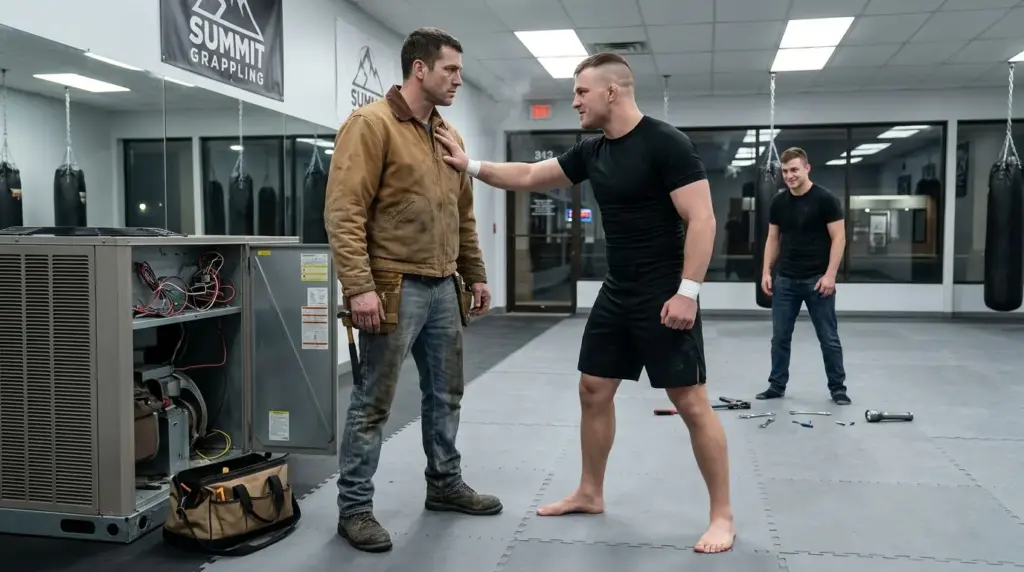
Inside, Cole knelt beside a massive commercial HVAC unit in the back corner of the mat space.
A flashlight was clenched between his teeth.
His hands were a map of pale scars and deep-set grease, the kind of grime no amount of pumice soap ever fully removed.
He liked the grease.
It was honest.
It meant he had fixed something broken instead of breaking something whole.
He reached into the metal housing with a socket wrench, feeling blindly for the stripped bolt behind the blower motor. The metal was cold enough to sting. Outside, a bitter November wind rattled the aluminum siding of the building, which was exactly why the dojo owner had called him in a panic three hours earlier.
The heat was dead.
Morning jiu-jitsu classes would freeze to the mats.
Cole gave the wrench a sharp jerk.
The bolt gave with a satisfying squeak.
He exhaled slowly. In the frigid room, the breath plumed faintly and vanished.
He liked working after hours.
It meant he did not have to talk to anyone.
Did not have to put on the polite, empty smile he used to navigate civilian life.
Cole was thirty-four, but his knees felt fifty. His lower back carried a permanent ache from a bad static line jump more than a decade earlier. His left shoulder popped every time he raised his arm past ninety degrees.
The military had taken the best parts of his cartilage and his sleep.
It had left him with an honorable discharge, a pension that barely covered rent, and a desperate need for quiet.
So he fixed air conditioners.
He fixed transmissions.
He fixed wiring.
He kept his head down.
Behind him, the dojo stretched under harsh fluorescent lights.
Two thousand square feet of pristine gray puzzle mats. Heavy bags hanging from steel chains. Mirrors lining the far wall, reflecting the empty room back at itself.
It was a place designed for violence, packaged neatly and sold to suburban professionals who wanted to sweat out their stress before returning to offices, mortgages, and weekend tournaments.
Cole wiped black oil from his forehead with the back of his forearm.
He avoided the mirrors.
When he looked at them, he did not see the mechanic in the faded Carhartt jacket.
He saw Helmand dust.
Empty bunks.
A stretcher.
A door opening too fast.
“Just the igniter switch,” he muttered to himself, tossing the bad part into his canvas tool bag. It clanked against a pair of heavy pliers. “Swap it, test it, go home, feed the dog.”
He reached into his jacket pocket for the replacement part.
Almost done.
Another twenty minutes, and he could lock the door behind him, climb into his beat-up Ford Ranger, and fade back into the background noise of the city.
Then the heavy glass front door swung open.
It slammed against the stop with a sharp crack that echoed across the room.
Cole flinched.
Barely.
A microscopic tightening of the shoulders. A shift of weight from his knees to the balls of his feet. His hand paused inside his jacket pocket.
He did not turn around.
He did not need to.
His ears had already tuned themselves to the intrusion.
Two voices.
Loud.
Brash.
The heavy squeak and thud of expensive athletic shoes on the hardwood entryway.
“I’m telling you, the guy’s guard is a joke,” one voice echoed, bouncing off the mirrored walls. “I passed it three times. He’s slow.”
“He’s not slow, Trent,” the second voice replied. Younger. Higher. Just as arrogant. “He’s just old. You shouldn’t be proud of sweeping a guy who does taxes for a living.”
Cole kept his eyes on the HVAC wires, but his mind had already mapped the room.
Entrance, fifty feet behind him at six o’clock.
Side exit, fifteen feet left at nine o’clock.
Tool bag within reach, heavy enough to swing if needed.
Primary weapon: distance.
Always distance.
He forced his heart rate down, pushing the spike of adrenaline back into the dark corner of his chest.
Just guys.
Civilian guys.
He went back to stripping wire.
Footsteps moved from hardwood onto the mats.
Bare feet now.
Slap.
Slap.
Slap.
Cole finally glanced over his shoulder.
Trent and Logan.
He did not know their names yet, but he knew their type.
They were carbon copies of every privileged aggressive kid who had ever washed out of basic training because they could not tolerate someone else holding authority.
Trent was the older one, maybe twenty-five. Built like a fire hydrant. Thick neck. Wide shoulders. Cauliflower ear worn like a badge. He wore a tight rash guard that showed exactly how badly he wanted people to know he trained.